· 3 min read
The hidden risks of legacy equipment in your factory
Old machines that still run well can hide obsolete controls, missing backups and lost knowledge. Here is how to find the risks before a breakdown finds them for you.
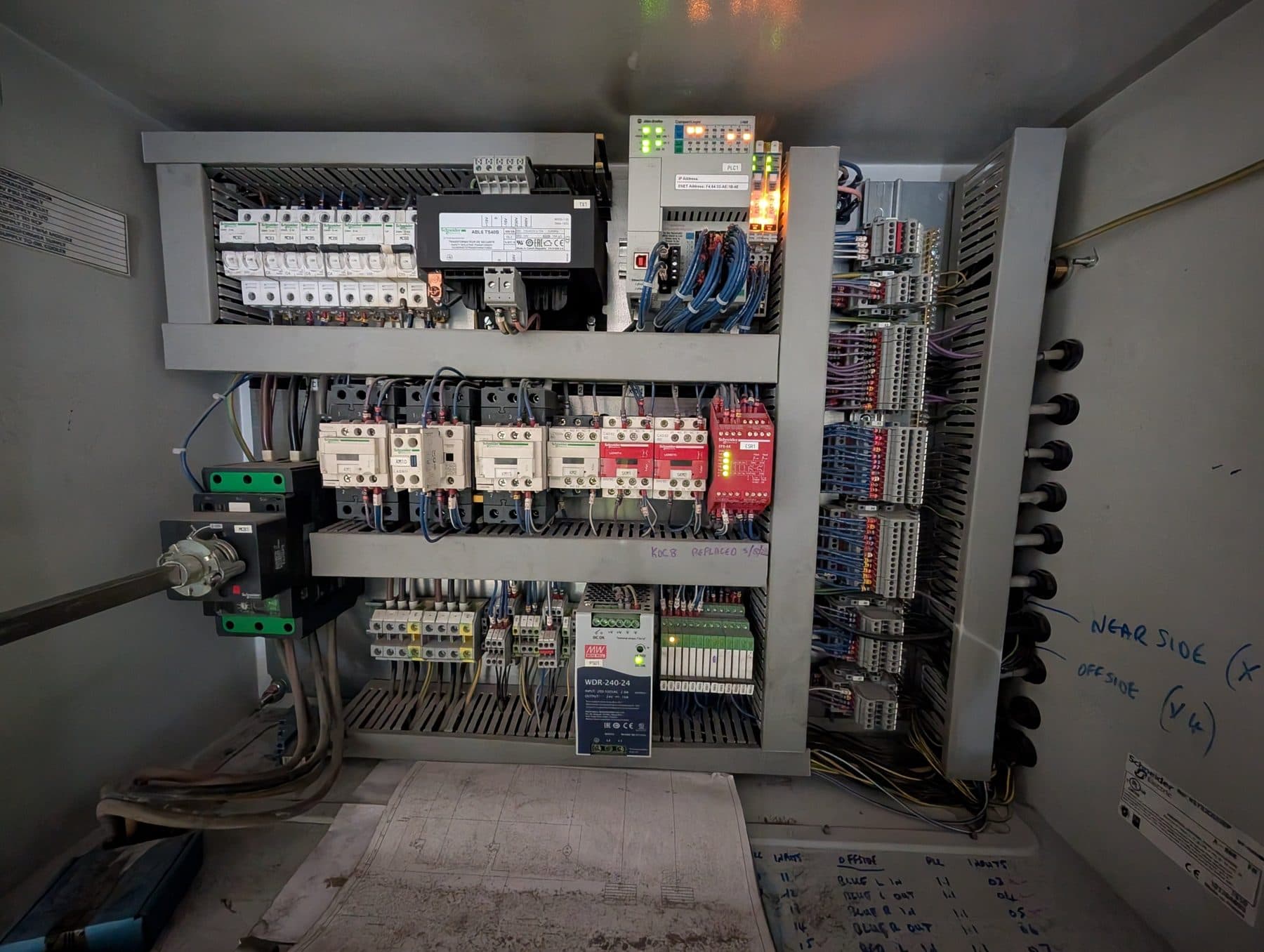
Most factories have machines that are older than some of the people running them. Mechanically, many are fine: steel frames, gearboxes and pumps can last decades with decent maintenance. The weak point is usually the control system, and the problem with an ageing control system is that it gives no warning. It works perfectly right up until the day it doesn't.
These are the risks we see most often when we walk round a site, and what to do about them.
1. Parts you can no longer buy
PLCs, HMIs, drives and bespoke control boards all reach end of life. Once a manufacturer stops making a part, spares come from the second-hand market, at rising prices and with no guarantee they work. Bespoke circuit boards are worse: when one fails there may be nothing to buy at all.
On an asphalt plant filter, a failed obsolete control board left the valve sequences with no replacement available. The fix was a standard PLC, but it had to be done after the failure rather than before it.
2. A program nobody has a copy of
Ask who has the current backup of a critical machine's PLC program. Often the answer is "the original installer", "it's on an old laptop somewhere", or silence. Without a backup, a failed CPU is no longer a part swap. It is a rebuild from scratch, with the line stopped while it happens.
3. Knowledge that has walked out of the door
The company that built the machine may have closed. The engineer who understood the code may have retired. What is left is a program with no comments, modified over the years, and a machine people are nervous to touch. That was the situation on a spiral blast freezer we upgraded: the original builder was out of business, so we reverse engineered the program from a backup before rebuilding it.
4. Software that needs an old laptop
Many older platforms need programming software that only runs on old versions of Windows, with licences that cannot be moved and cables that are hard to find. When that one laptop dies, so does your ability to change or diagnose the machine.
5. No data, and no way to get it
Older controllers were never designed to share data. That leaves the machine as a blind spot when you want to measure output, downtime or energy, and it often means production figures are still written down by hand.
6. Hard to fault-find
Many older machines have no operator screen, or one with cryptic alarms. Every stoppage needs an electrician with drawings and a meter, which turns a two-minute fault into an hour of lost production.
What to do about it
You do not need to replace everything at once. A sensible order is:
- List what you have. Every PLC, HMI and drive on site, its model, and whether it is still supported.
- Back everything up. Make sure a current copy of every program is stored somewhere safe, not just on the machine. This is the cheapest risk reduction there is.
- Rank by risk. How critical is the machine to production, and how obsolete are its controls? The machines that score high on both go to the top of the list.
- Plan upgrades into shutdowns. An upgrade that is built and tested off site can often be installed in a planned shutdown. On a precast handler, installation and SAT took a single day.
- Standardise as you go. Moving to one or two PLC platforms means fewer software packages, fewer spares and a maintenance team that knows the kit.
Where we can help
We back up and document existing machines, assess what is at risk, and upgrade obsolete controls while keeping the machine working the way your operators know. If you have equipment that worries you, send us a few details and a photo of the panel.
Related: Legacy upgrades, Support